


Newsletters are still one of the most valuable tools you can build as a creator. While social platforms come and go (and algorithms keep shifting under our feet), an email list is something you actually own. A well-crafted newsletter helps you stay connected with your audience, drive traffic to your platform, and build something that doesn’t disappear when an app changes its rules.
But picking the right newsletter platform has gotten harder, not easier. The free plans I would have recommended a year or two ago have changed dramatically — some have gotten more generous, but several of the best-known names have slashed their free tiers in 2025 and 2026. If you’re starting from scratch (or considering switching), the landscape looks different than it did even 12 months ago.
Here’s an honest look at the best free newsletter services available in 2026, including which ones have become more compelling and which ones aren’t what they used to be.
A quick note on what’s changed
Before getting into specific platforms, the most important thing to understand: the era of ultra-generous free plans from the big legacy players is largely over. Mailchimp and MailerLite, both staples of “best free email tool” lists for years, have meaningfully reduced what they offer for free. Meanwhile, newer platforms like Kit (formerly ConvertKit), Beehiiv, EmailOctopus, and Sender have stepped in with more generous free tiers aimed specifically at creators.
That shift matters because it changes who the “right” platform is for new creators. If you read an article from 2023 recommending Mailchimp as the best free option, that advice doesn’t hold up today. Here’s where things actually stand.
1. Kit (formerly ConvertKit) — Best overall for creators
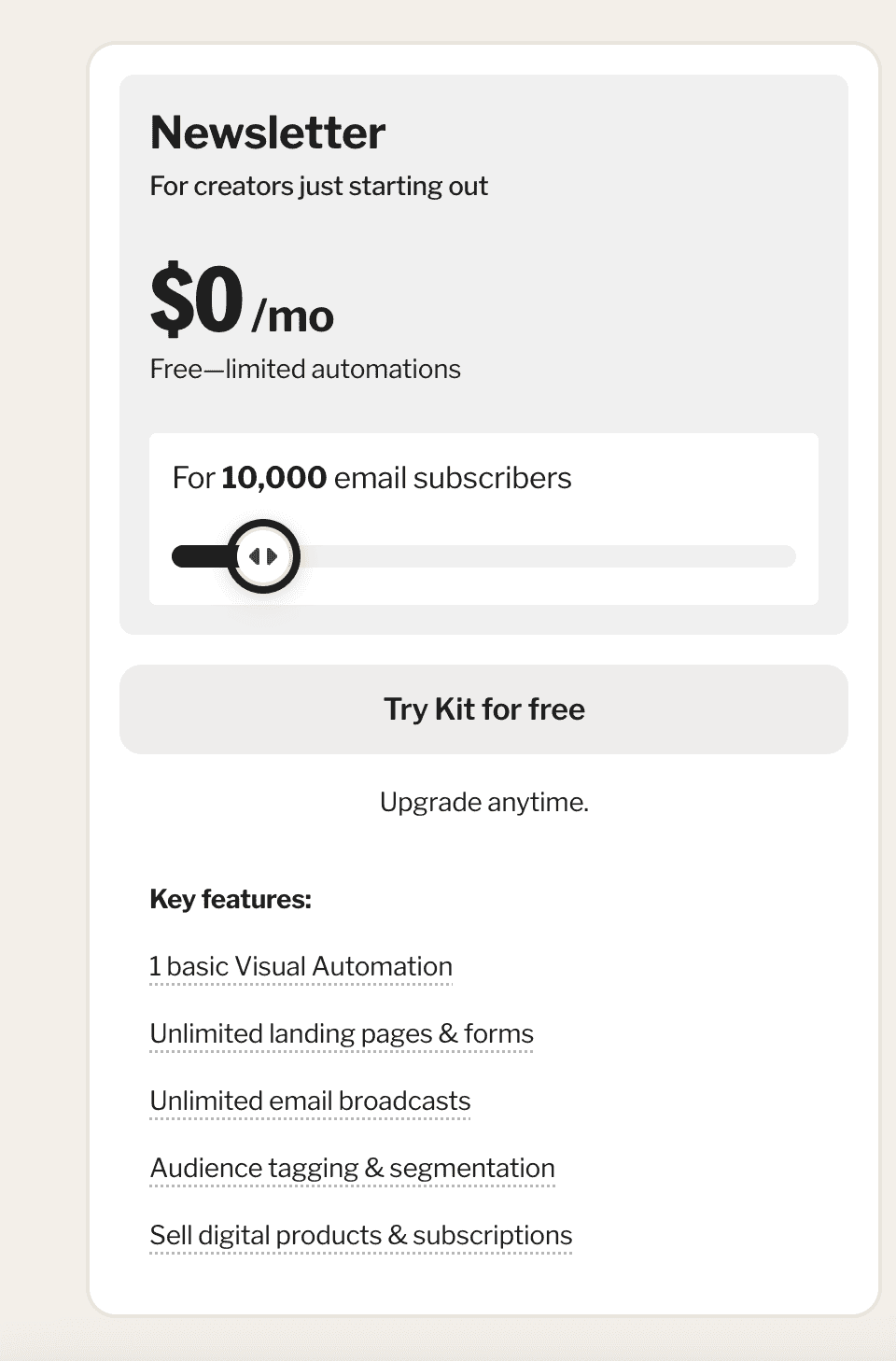
Free plan: Up to 10,000 subscribers, unlimited email sends, one automation, one email sequence
ConvertKit officially rebranded to Kit in October 2024 — same company, same product, just a new name. If you’ve heard of ConvertKit, that’s what people are talking about.
Kit’s free Newsletter Plan is one of the most generous in the industry, and it’s specifically built around creators rather than e-commerce businesses. You get:
- Up to 10,000 subscribers
- Unlimited email broadcasts
- Unlimited landing pages and forms
- Audience tagging and segmentation
- The ability to sell digital products and accept paid subscriptions (Kit takes a small transaction fee)
- One automated email sequence and one visual automation
The honest caveats: The free plan does require Kit branding on your forms and emails, and it includes one Kit-managed Recommendation slot (where Kit may earn revenue from creator recommendations they place). You also lose access to advanced automations, third-party integrations, and detailed reporting unless you upgrade.
Why I recommend it: If you’re a creator — bloggers, podcasters, course makers, newsletter writers — Kit is built for you specifically. The 10,000-subscriber free plan is generous enough that most creators can grow for years before needing to pay. The interface is clean, the deliverability is strong, and the platform makes it easy to monetize as you grow. This is the platform I use for all my sites.
Heads up on pricing if you grow: Kit raised prices in September 2025, and the paid Creator plan now starts at $39/month for 1,000 subscribers (or $33/month with annual billing). That’s a real jump from where it used to be. Worth knowing if you’re thinking long-term.
Best for: Creators serious about building a long-term email list with room to grow.
2. Substack — Best for paid newsletters and writers
Free plan: Unlimited subscribers, unlimited sends, full access to publishing tools
Substack hasn’t changed much, and that’s mostly a good thing. It’s still the dominant platform for writers, journalists, and creators who want to publish newsletters and offer paid subscriptions.
Free plan features:
- Unlimited subscribers and email sends
- Free publishing tools (web, email, mobile app)
- Built-in subscriber acquisition through the Substack network and recommendations
- Customizable design (within limits)
- Built-in analytics
- Optional paid subscription functionality
The model: Substack is technically free until you start charging for subscriptions, at which point Substack takes 10% of paid subscriber revenue (plus payment processing fees). That’s a meaningful cut, but it’s also a “no money up front, no risk” model — you only pay when you’re earning.
Why I recommend it: If you’re a writer or someone whose primary content is the newsletter itself (rather than driving traffic to a separate website), Substack is genuinely hard to beat. The built-in discovery network helps with audience growth in a way no other platform offers, and the editor is purpose-built for long-form writing.
The trade-offs: You don’t fully own your audience the way you would with a traditional email tool — your subscribers are tied to Substack’s platform, and the design customization is limited. Substack also has cultural/political baggage some creators care about, depending on your views. Worth knowing.
Best for: Writers, journalists, essayists, and anyone whose business model centers on the newsletter itself rather than driving traffic elsewhere.
3. Beehiiv — Best for serious newsletter builders
Free plan: Up to 2,500 subscribers, unlimited sends, basic features
Beehiiv didn’t exist when most “best newsletter platforms” articles were originally written, and it’s now one of the strongest options on the market — especially for newsletter-first businesses.
Free plan features:
- Up to 2,500 subscribers
- Unlimited email sends
- Custom newsletter website
- Basic analytics
- Audience segmentation
- A built-in referral program (huge for organic growth)
Why I recommend it: Beehiiv was built by people who ran a major newsletter (Morning Brew) and designed the tool around what newsletter operators actually need. The deliverability is excellent, the editor is fast and modern, and the referral program is built in — which most other platforms make you pay extra for.
The trade-offs: Free plan branding appears in your emails. Some advanced features (like premium subscriptions, advanced automations, and more detailed analytics) require upgrading.Best for: Creators who see their newsletter as a real publication or business, not just a marketing channel for something else.
4. EmailOctopus — Best for budget-conscious lists
Free plan: Up to 2,500 subscribers, 10,000 emails per month
EmailOctopus is a quieter player but offers one of the most generous free plans available, especially compared to what Mailchimp and MailerLite now offer.
Free plan features:
- 2,500 subscribers
- 10,000 emails per month
- Drag-and-drop email designer
- Landing pages
- Basic automation
- Form builder
Why I recommend it: If your priority is “the most subscribers and emails I can send for free,” EmailOctopus is genuinely hard to beat. It’s straightforward, reliable, and the paid plans are significantly cheaper than Kit or Beehiiv if you ever need to upgrade.
The trade-offs: EmailOctopus branding on free-tier emails. The interface and feature set are less polished than Kit or Beehiiv — it’s functional, not flashy. Less optimized for creator-specific needs like paid subscriptions.
Best for: Small businesses, freelancers, and creators who want a generous free plan without prioritizing creator-specific features.
5. MailerLite — Still solid, but less generous than it used to be
Free plan: Up to 500 subscribers, 12,000 emails per month
MailerLite used to be a top recommendation for free newsletter services, but in September 2025 they cut the free plan from 1,000 subscribers to 500. The email send limit (12,000/month) stayed the same, but the subscriber cap getting halved is a meaningful downgrade.
Free plan features:
- 500 subscribers
- 12,000 email sends per month
- Drag-and-drop email builder
- 10 landing pages
- Basic automation
- Website builder included
Why it’s still on this list: MailerLite’s interface is genuinely beginner-friendly, and the platform offers more features than most competitors (websites, automations, A/B testing) on the free tier. If you have a small list and want a lot of functionality without paying, it’s still a viable option.
The honest caveat: That 500-subscriber cap is restrictive enough that most creators will outgrow it quickly. You’ll also have MailerLite branding on your emails on the free plan.
Best for: Beginners who want full-featured email marketing tools and don’t expect to exceed 500 subscribers anytime soon.
6. Mailchimp — Once the gold standard, now barely usable for free
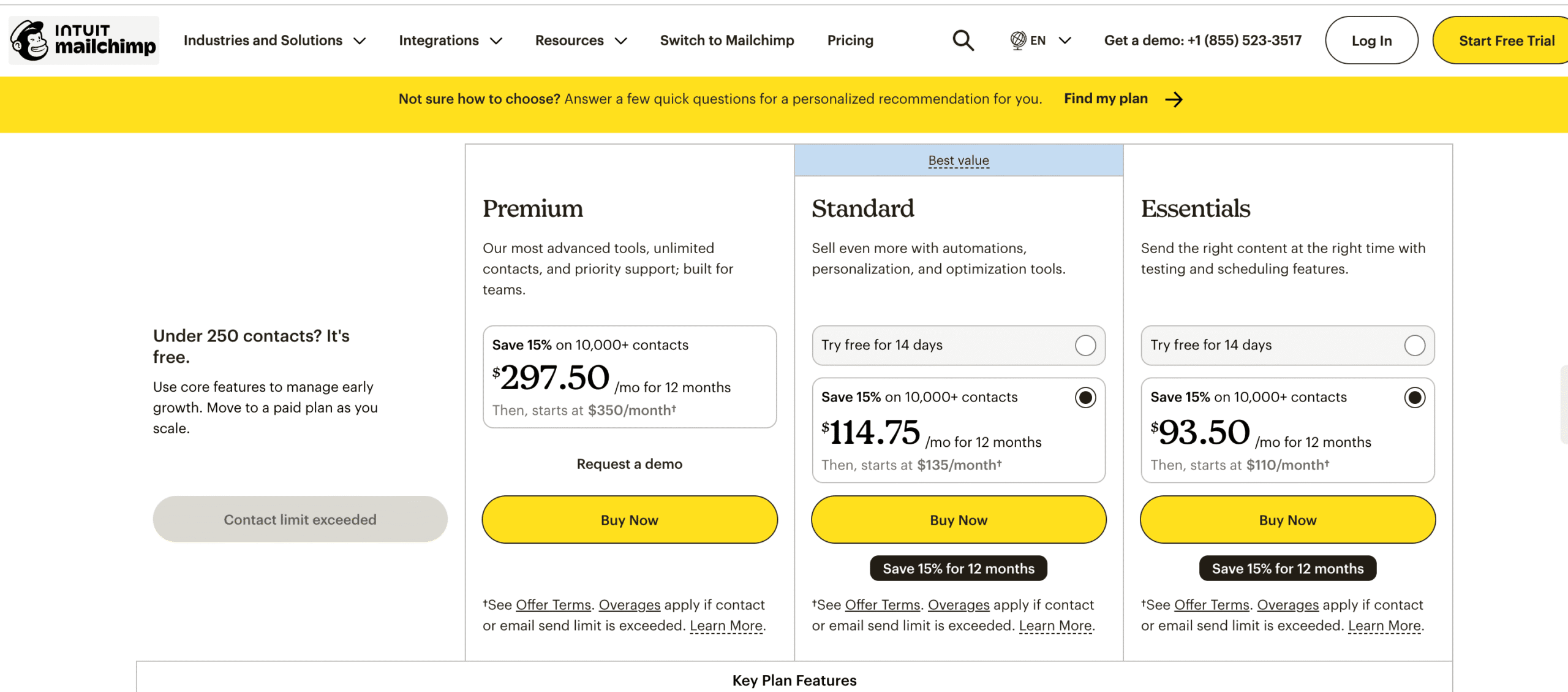
Free plan: Up to 250 contacts, 500 emails per month, 250 daily send limit
I have to be honest about Mailchimp because it shows up on so many “best free email” lists — but in 2026, the free plan has been so significantly reduced that I can’t recommend it for most creators.
The current free plan limits:
- 250 contacts (down from 2,000 just a few years ago)
- 500 email sends per month total
- 250 daily send limit
- No multi-step automations
- No email scheduling
- Mailchimp branding on every email
- Customer support only for the first 30 days
The reality: With 250 contacts and 500 monthly sends, you can’t even send two newsletters a month to a full list of 250 subscribers. Mailchimp has reduced its free plan repeatedly since Intuit acquired the company in 2021, and the trajectory hasn’t reversed.
Should you use it? Honestly, only if you have a tiny list (under 250 contacts), send infrequently, and specifically want Mailchimp’s interface or integrations. For everyone else, Kit, Beehiiv, EmailOctopus, or even Substack offer dramatically more on the free tier.
Best for: Very small projects, hobby newsletters, or specific use cases where Mailchimp’s e-commerce integrations matter more than the free plan limits.
How to pick the right one for you
If you’re staring at this list and not sure where to start, here’s a quick decision framework based on what kind of creator you are:
- You’re a writer or journalist who wants to monetize: Start with Substack
- You’re a creator with multiple platforms (blog, podcast, etc.) who wants to grow an email list: Start with Kit
- You see your newsletter as a real publication or business: Start with Beehiiv
- You want maximum free subscribers and don’t need creator-specific features: Start with EmailOctopus
- You have a small, simple list and want a beginner-friendly tool: MailerLite is fine — just know the 500-subscriber ceiling
- You really want Mailchimp specifically: Use it, but with realistic expectations about the free plan
The good news: most of these platforms make it relatively easy to migrate later if you outgrow your initial choice. Don’t let “picking the perfect one” stop you from starting — pick a reasonable fit, get going, and switch later if you need to.
A note on what to look for going forward
Free plans across the industry have been getting tighter, not more generous. If a platform’s free tier is critical to your decision, pay attention to two things before committing:
- How recently did they last change their pricing? Platforms that have cut their free plans recently (Mailchimp, MailerLite) may do it again.
- What’s their incentive structure? Platforms that monetize through transaction fees on creator earnings (Kit, Substack, Beehiiv) tend to keep free tiers generous because they make money when creators succeed. Platforms that monetize purely through subscriber-tier upgrades (Mailchimp) have more incentive to push you to pay.
It’s not a perfect rule, but it explains why the trends have shaken out the way they have in 2025-2026.
The bottom line
The best free newsletter service in 2026 is probably Kit for most creators, Substack for writers, or Beehiiv if you’re treating your newsletter like a real publication. Mailchimp and MailerLite — the old default recommendations — have both reduced their free plans significantly and aren’t the obvious choices they used to be. I personally use Kit on all my sites and I’m pretty happy with it, although once you switch to a paid tier, it’s not cheap.
Whatever you pick, the most important thing is to start. The platform you choose matters less than actually showing up consistently and delivering something your readers want to open.
Have a favorite newsletter platform I missed, or thoughts on one of the ones I mentioned? Drop me a note — this is a guide I update regularly as the landscape shifts.